Wall Street Says Trillion Dollar Debt Spiral Is Fine
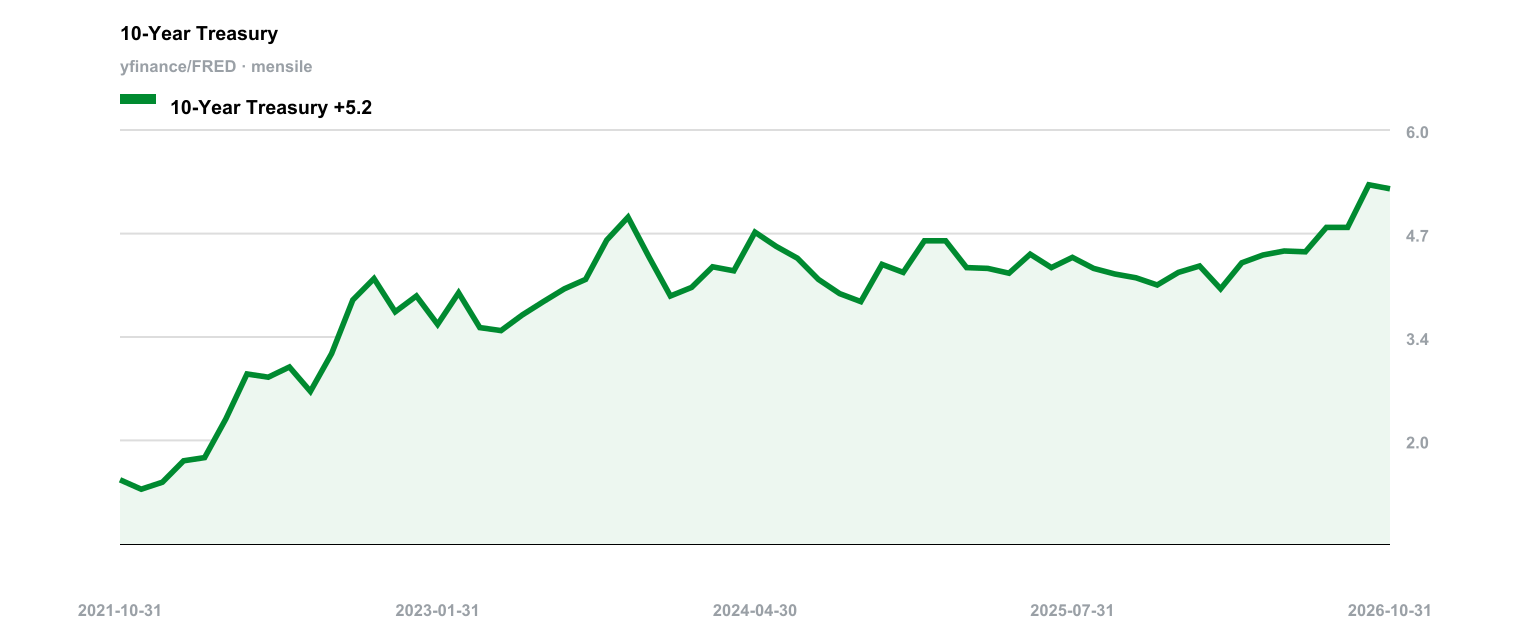
The 10-year Treasury yield crossed 5% this autumn, and the U.S. government spent roughly $1.05 trillion on net interest in the first eleven months of fiscal 2026. When a country pays more to service its debt than it spends on national defense, people start using words like spiral. The question is whether that spiral has already begun or whether the market is simply mispricing a strong economy.
Gennadiy Goldberg and Molly Brooks at TD Securities argue for the latter. In a recent note, they wrote that a fiscal apocalypse isn't upon the U.S. just yet. Their case rests partly on the observation that the latest surge in yields may reflect a surprisingly resilient economy rather than genuine fear over government borrowing. Other bond market experts echo this view, suggesting Washington remains some distance from a breaking point. It's a comforting story, and comforting stories tend to travel fast on trading desks.
Look past the headline reassurance and examine the arithmetic the same strategists published. If yields stay around current levels, Goldberg and Brooks project federal financing costs reaching $1.4 trillion in fiscal 2027, $1.5 trillion in 2028, and $1.6 trillion in 2029. That's half a trillion dollars in additional annual interest expense arriving within three years. The authors use these figures to argue against panic, but the numbers themselves describe a compounding burden that grows faster than any plausible tax base. Reading those projections as evidence of stability requires you to believe that adding $500 billion to an annual bill doesn't change the creditworthiness of the borrower paying it.
The main reason that trajectory hasn't yet forced a reckoning comes down to the calendar. The weighted-average maturity of outstanding U.S. government debt sits at about 5.9 years. Washington isn't refinancing the entire stock of obligations at today's 5% yield. Bonds issued when rates were near zero still sit on the books, paying coupons that look like relics. This maturity profile acts as a buffer; other observers lean on it heavily when dismissing fears of an immediate funding squeeze.
But every quarter, another tranche of cheap legacy debt matures, and the Treasury must replace it by issuing new paper at prevailing rates. The 5.9-year average means the full impact of higher borrowing costs takes time to arrive, though it also guarantees arrival. By the time the rollover completes its work, the interest bill will have grown by hundreds of billions annually. Publishing forecasts that show interest costs accelerating by hundreds of billions of dollars in a very short window while simultaneously telling investors not to worry suggests a bet that the economy outruns the math before the old bonds fully roll off.
Maybe the economy outruns the math; maybe bond buyers decide 5% is generous enough to fund the gap indefinitely. But relying on a rolling maturity schedule to dismiss a structural deficit problem confuses the calendar with the cure. Time doesn't solve a deficit; it only reveals who was wrong first.
References
CNBC, 10/05/2026
Surging Treasury yields don’t signal a U.S. 'fiscal apocalypse' — yet
Key takeaways
- Goldberg and Brooks claim a fiscal apocalypse isn't imminent, though their own cost projections rise sharply.
- The authors attribute high yields partly to economic resilience rather than sovereign debt concerns.
- TD Securities argues the 5.9-year average debt maturity shields the budget from immediate refinancing pressure.