
Paris Now Pays More Than Rome
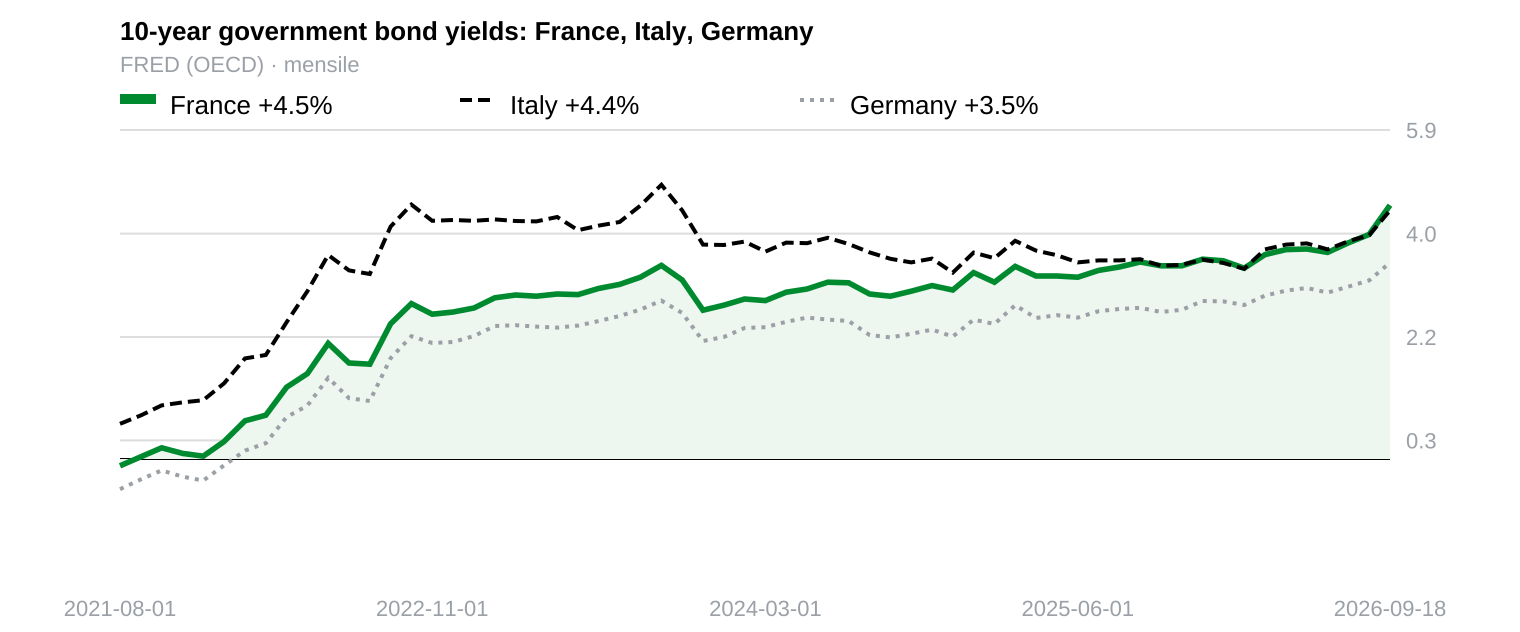
France now pays more to borrow than Italy. This isn't a data glitch. It's a structural break in the hierarchy of European sovereign risk. For years, Paris enjoyed a premium for its political stability while Rome paid for fiscal looseness. That logic is dead. The market no longer cares about debt-to-GDP ratios in isolation. It cares about who can actually pass a budget.
Look at the spreads. On September 18, the gap between French ten-year bonds and German bunds crossed 100 basis points. We hadn't seen that level since 2012. At the same time, the Italian spread against Germany sat at 91 basis points. Italy’s borrowing cost was lower. This inversion defies the textbook. France holds a better credit rating. Its debt burden relative to the economy is lighter. Yet traders demand a higher premium from Paris. The numbers don't lie, even if they confuse the analysts.
The driver here isn't macroeconomic fundamentals. It's political paralysis. Paris has missed deficit targets repeatedly. The government can't pass credible austerity measures because parliament is fragmented. No coalition holds a stable majority. Investors see a state that can't make hard choices. They price in the risk of further drift. The inability to govern is now a line item on the balance sheet. Markets hate uncertainty more than they hate bad news. Bad news can be priced. Uncertainty cannot.
Contrast this with Rome. Italy still carries a massive debt load. Its growth remains modest. But the deficit trajectory is under control. The current administration has maintained a degree of legislative coherence that Paris lacks. There is no existential gridlock blocking the budget process. Investors may dislike Italian debt levels, but they understand the rules of the game. In France, the rules seem up for negotiation every week. The market prefers a known quantity with high leverage to an unknown quantity with moderate leverage.
This shift signals that the 'safe haven' status of French debt is eroding. Investors are no longer willing to accept negligible yields for sovereign risk once considered trivial compared to the periphery. They demand compensation for fiscal indiscipline. The premium France pays is purely political. It reflects a loss of confidence in the state’s ability to enforce its own fiscal promises. Italy, by comparison, has restored a baseline of predictability. That predictability is worth money.
The inversion of these spreads is a warning shot. It tells us that markets are forward-looking machines, not backward-looking accountants. They do not reward past prudence if present governance fails. France is paying for its political dysfunction. Italy is being rewarded for its procedural stability. This dynamic may reverse if Paris finds a way to govern or if Rome stumbles. But for now, the bond market has made its choice. It trusts the technocrat in Rome more than the politician in Paris. France has the lower debt and the better credit rating, yet on September 18 it paid more than Italy to borrow: over 100 basis points above Germany, against 91. If that is how markets reward good fundamentals, what would a punishment look like?
References
Le Figaro, 09/18/2026
Après les annonces budgétaires de Lecornu, regain de tension sur les taux d'intérêt français
Reuters via Global Banking & Finance, 09/21/2026
Why France's Bond Risk Premium Hits 2012 Highs Amid Budget Woes
La Libre / AFP, 09/17/2026
Lecornu présente un budget offensif, avec 54 milliards d'économies
Le Monde (English edition), 09/18/2026
Spain has managed to bring its public finances under control. France has not.
Key takeaways
- The spread between French and German bonds exceeded 100 basis points, surpassing the Italian spread, which suggests investors view French political gridlock as a more immediate risk than Italian debt levels.
- The primary driver of this anomaly is not economic data but the inability of the French government to pass credible fiscal measures due to parliamentary fragmentation, whereas Italy maintains a more controlled deficit trajectory.
- Market participants appear to be repricing French sovereign debt to reflect a loss of 'safe haven' status, demanding higher yields for political uncertainty while accepting lower yields for Italy’s relative legislative predictability.