
The Great Illusion of Beating the Market
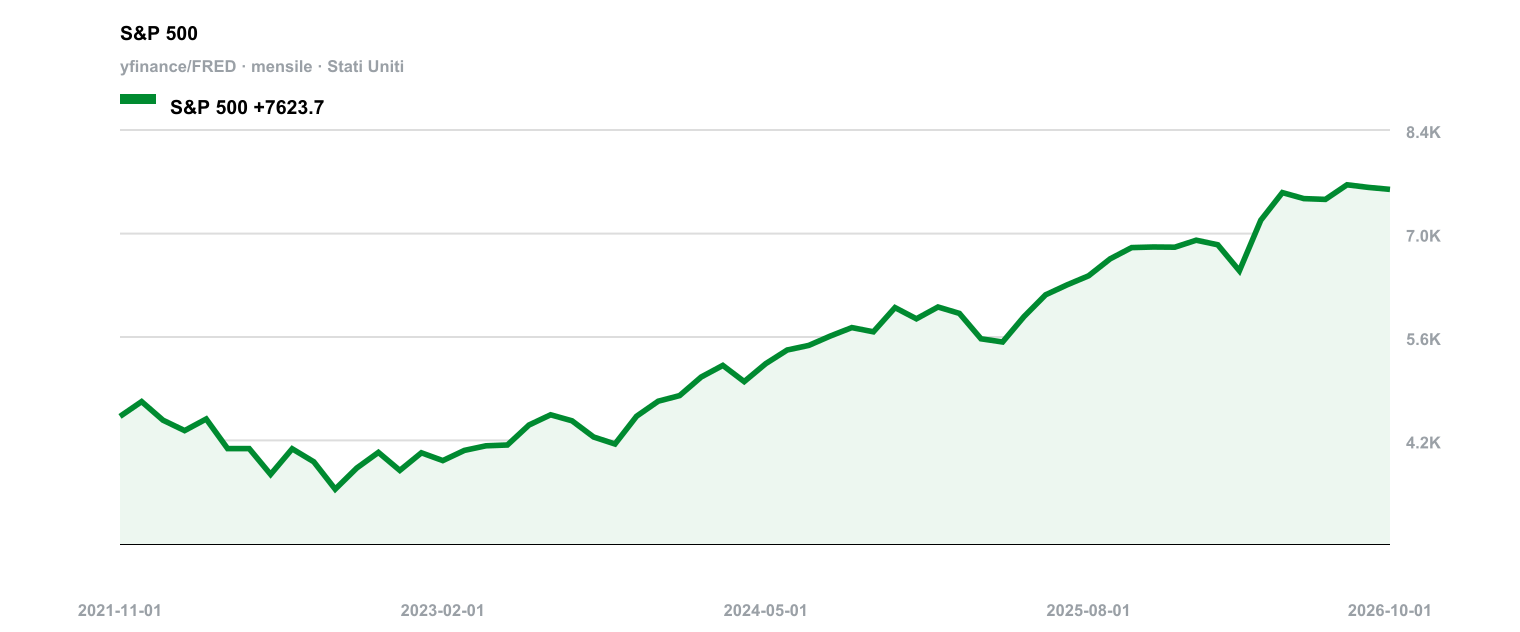
Every January, somewhere, a glossy bank brochure explains to its clients why this year the bank's funds will beat the S&P 500. Come December, the index has usually beaten them, impassive as ever, and the brochure is quietly binned. The industry has played this game for decades, with thousands of funds and some of the best-paid professionals in finance, and the result keeps arriving in the same envelope. Nobody needs a brochure to learn that most of these funds lose. The interesting part is what happens to the few who don't, and why anyone should believe they'll manage it again.
Let's start with the report card that nobody at the bank quotes. The S&P Indices Versus Active (SPIVA) scorecard published by S&P Dow Jones Indices in March 2026 covers periods ending December 2025. Over ten years, 90.43% of active US domestic equity funds trailed the S&P Composite 1500. Over twenty, 95.01%. Large caps did only a little better: 85.59% behind the S&P 500 after ten years. Even 2025 offered no alibi: roughly 79% of large-cap funds lagged the index, the fourth-worst year for active large-cap managers in the scorecard's 25-year history.
And those percentages flatter the industry. The scorecard counts the casualties: only 64.58% of the domestic funds that existed ten years earlier were still running, and after twenty years that share fell to 36.53%. The rest were merged or liquidated, which is not usually a reward for good performance. Keep that in mind the next time a fund advertises its ten-year record. It is the record of the ones that stayed.
Fine, say a minority do beat the index. Skill or luck? Barras et al. (2010) put the question to a test built to strip out funds that look brilliant by chance alone, because with thousands of funds, somebody always has a lucky streak. They studied 2,076 actively managed US equity funds from 1975 to 2006. Net of expenses, 75.4% had zero alpha, 24.0% had negative alpha, and the 0.6% with positive alpha could not be told apart from zero. Before fees, 9.6% looked skilled. But the authors argue that expenses absorbed nearly all of that surplus, and that a significant share of skilled funds before 1996 had almost vanished by 2006. Whoever owns the talent, it seems, collects the proceeds personally.
The counterargument has a 2025 date on it. Mateus et al. (2025) studied 603 Large Cap Value and 785 Large Cap Growth funds from 1990 to 2020 and proposed a refinement of the standard Carhart model that, they argue, finds funds beating both benchmark and peer group, and doing so again 36 months later. But their 8,437 winners in Large Cap Value, against 3,944 under the standard approach, are not funds: they are fund-periods, counted across 300 rolling windows that overlap month after month. A winner needs only a positive alpha significant at the 10% level in a standard t-test, and the paper describes no test against pure luck of the kind Barras et al. ran. Some results are available only on request, which hardly makes peer evaluation easy. And the model is the authors' own.
None of this proves that no manager has ever beaten the market. It shows only how rare the feat is, and how easily luck passes for skill. The index has no fees to recover and no skill to prove.
References
S&P Dow Jones Indices, 03/03/2026
SPIVA U.S. Scorecard Year-End 2025
Laurent Barras, Olivier Scaillet, Russ Wermers (2010)
False Discoveries in Mutual Fund Performance: Measuring Luck in Estimated Alphas
Cesario Mateus, Irina B. Mateus, Natasa Todorovic (2025)
Mutual fund performance: the model for selecting persistent winners
Key takeaways
- Roughly nine in ten US domestic equity funds trailed their benchmark over ten years, according to the S&P Dow Jones Indices scorecard of March 2026.
- Barras et al. (2010) argue that after fees only 0.6% of funds showed skill, a share statistically indistinguishable from zero.
- Mateus et al. (2025) claim their own model finds persistent winners, possibly true, but it counts fund-periods and describes no test against luck.